Your VP of Sales forwards you a Salesforce announcement with one line on top: "Can Hunter replace two of our SDRs?" It is a reasonable question. It is also the second question.
On September 11 Salesforce gave seven of its Agentforce agents names, job titles and, in one case, memory that survives between conversations. The Salesforce named AI agents - Piper, Hunter, Casey, Fin, Carter, Paige and Marshall - are not seven new products. They are prebuilt agents repackaged as personas with defined jobs, plus one capability underneath that is genuinely new.
The first question, the one that decides your Q4 budget, is which of them you can actually turn on before January. Here is the roster, each status straight from Salesforce's announcement, and what the published US pricing works out to.
What are Salesforce's named AI agents, and which ones are live?
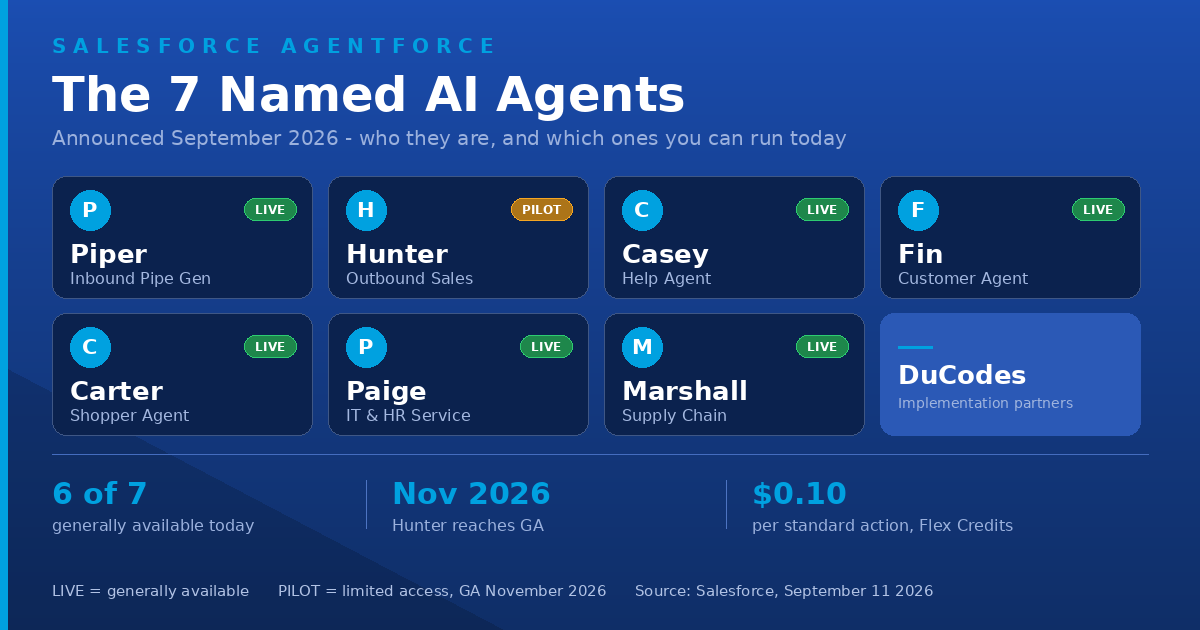
Six of the seven are generally available today. One - Hunter, the outbound sales agent, and the one most people are asking about - is in pilot until November.
| Agent | Job title | What it does | Status |
|---|---|---|---|
| Piper | Inbound Pipe Gen Agent | Engages, qualifies and converts inbound leads across your website and email | GA now |
| Hunter | Outbound Sales Agent | Runs outbound pipeline work - research, outreach, follow-up - alongside a seller over days and weeks | Pilot now, GA November 2026 |
| Casey | Help Agent | Customer service across voice, SMS, WhatsApp and web chat, including FAQs, returns and account management | GA now |
| Fin | Customer Agent | Resolves more complex customer service workflows across channels | GA now |
| Carter | Shopper Agent | Product discovery, comparisons and in-chat checkout on commerce sites | GA now |
| Paige | IT and HR Service Agent | Employee requests through Slack, portals and existing workplace tools | GA now |
| Marshall | Supply Chain Agent | Back-office orchestration and deterministic execution of manual supply chain work | GA now |
Two pieces of plumbing came with the announcement and matter more than the names.
The Long-Horizon Runtime lets an agent pursue a goal across days and weeks rather than resetting at the end of every conversation, with memory, durable execution and the ability to be steered mid-task. Hunter is the only agent built on it today. Salesforce says the others get it later - worth remembering the next time someone calls Agentforce autonomous, because right now that describes one agent, and that agent is in pilot.
Agent Script is Salesforce's open-source language for defining agent behavior, so a developer can force an agent down a specific path instead of hoping the model picks it. If you have ever watched a demo agent improvise its way into a wrong answer, this is the answer to that.
Which of these actually fits a US mid-market team
For most US companies between 20 and 500 people, the available agent is also the more useful one, which is a rare piece of luck.
Piper works inbound: someone lands on your site or replies to a campaign, and Piper qualifies and routes them. Hunter works outbound, against a target list. Companies at this size usually have an inbound leak long before an outbound gap - forms routing to the wrong rep, demo requests sitting until Monday, a contact-us inbox one person watches. Piper is aimed at exactly that, and Piper is GA.
That is only good news if your routing rules and lead data are already right, because an agent that qualifies leads inherits whatever logic you have. Point it at stale assignment rules and it will misroute faster and more consistently than any human did.
On the service side you now have two overlapping options, and the difference matters. Casey handles the high-volume, well-defined work - returns, account changes, FAQs - across voice, SMS, WhatsApp and chat. Fin is positioned for the messier multi-step cases. Fin also arrived through Salesforce's agreement to acquire Fin, formerly Intercom, for roughly $3.6 billion - a deal expected to close in Salesforce's fiscal Q4 of 2027. So it is listed as generally available while the company that built it is still being bought.
Our read for a mid-market US service team: start with Casey. It is native, it covers the volume cases that consume agent hours, and it carries no open integration question. Revisit Fin once the deal closes and the roadmap is public.
Paige is the quiet one worth a look if you run Slack. Employee IT and HR requests are high-volume and internal, so a wrong answer costs you an annoyed employee rather than a lost customer - a reasonable place to learn how these agents behave before one faces buyers.
How much do Salesforce's AI agents cost in the US?
Salesforce publishes three ways to pay, all in USD, and the one you pick changes the economics more than the agent you choose does.
- Flex Credits - consumption pricing by action: 20 credits for a standard action (US$0.10), 60 for a complex action (US$0.30), 120 for an advanced action (US$0.60).
- Agentforce add-ons - US$125 per user per month for Sales, Service and Field Service; US$150 for the Industries add-ons.
- Agentforce 1 editions - from US$550 per user per month, including 1 million Flex Credits and 2.5 million Data 360 credits per org per year. There is also an Agentforce User License at US$5 per user per month, which requires buying Flex Credits separately.
Run the arithmetic on that credit bundle, because the headline number misleads. One million Flex Credits at 20 credits per standard action is 50,000 standard actions a year - or roughly 16,600 complex ones, or 8,300 advanced. A single conversation can consume several actions. For a service team with real volume, an allowance that reads as a million is a few thousand conversations.
US timing is the other thing to price in. Hunter reaches GA in November, in the middle of calendar-year budget planning and alongside Winter '27 rolling into production orgs. If outbound agents are in your 2027 plan, you are committing budget in October for software you cannot evaluate until November.
If you operate outside the US, the pricing above is Salesforce's published USD list and your local list price and available editions may differ - worth confirming with your account executive rather than converting.
The catch nobody puts on the slide
Consumption pricing moves the risk from the purchase to the operation, and most teams are not set up for that.
With per-seat licensing you know the bill in advance and the worry is adoption. With Flex Credits the bill tracks what your agents do, and the action tier is decided by the work the agent performs, not by what you budgeted. A chatty agent and a disciplined one cost different amounts to run the same process. That is not a reason to avoid the model - it is a reason to meter one agent for a month before you deploy a second.
Salesforce is not alone in this. If you are comparing platforms, see how Zoho prices its Zia Agents by token consumption - the two vendors are arriving at the same commercial shape from opposite directions.
Then there is the prerequisite nobody itemizes. Every one of these agents answers from your data - knowledge articles, product records, routing rules, case history. An agent grounded in a knowledge base last reviewed two years ago answers confidently and wrongly at ten cents an action, and the low unit cost is exactly what stops anyone noticing for a quarter.
One smaller trap: Winter '27 lands in the same window as Hunter's GA, which puts your admin on a release test and a new agent at once.
Working out which of these your org can genuinely run - your edition, the state of the data they would read, which pricing model is cheaper at your volume - is an hour worth spending before the budget conversation rather than after it.
What to do before your Q4 planning meeting
Four steps, and the first two are yours to do without help.
- Pick one agent, not a strategy. For most teams that is Piper if your pain is inbound, Casey if it is service volume, Paige if you want a low-stakes place to learn. Name the one process it would own.
- Audit the data that agent would read - the routing rules, the knowledge articles, the case history. This is the work that decides whether the pilot succeeds, and it is entirely within your control today.
- Model both pricing paths at your real volume. Estimate actions per conversation, multiply by your monthly conversation count, and compare against the per-user add-on. One of the two will be obviously cheaper for you.
- Put Hunter in the 2027 column, not the Q4 one. Ask your AE for pilot access now if outbound matters, but do not build a plan that assumes November.
The teams that get value from this in 2027 will not be the ones that deployed all seven. They will be the ones that ran a single agent against clean data and knew its real cost per resolved case before anyone asked for a bigger budget.
Find out which of these you can run, in 30 minutes
Hunter reaches GA in November and Winter '27 is rolling into production orgs now, which makes the next few weeks the point where this stops being an announcement and starts being a budget line. DuCodes runs a free 30-minute Salesforce readiness review: we check your edition, your current Agentforce entitlements, the state of the data these agents would read, and whether Flex Credits or the per-user add-on is cheaper at your volume - then send you a one-page note on which agent to start with and what the first 90 days would realistically cost. Book a review.